


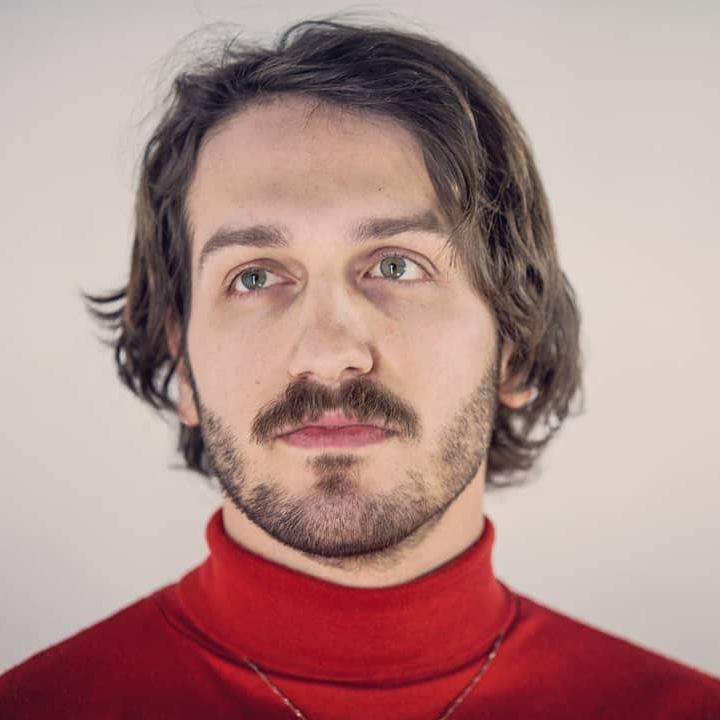
 Photo by Samer Ghani.
Cullah is an artist that recently came to UWSP with his band Cullah and the Comrades. Based in Milwaukee, Cullah performs often with the Comrades, as well as with his other group, the Copperheads. As a full-time musician, Cullah keeps busy, creating a new album every year.
I know that you produce a new album every year. How are you able to do this? I know it’s a lot of work to even produce one album.
Well, I don’t have a choice at some point. I’ve got some sickness inside me. Logistically, the way that I can do it every year is that I’m self-produced. I have a background in computer engineering and come from a pretty musical family. I fell in love with making music at a pretty early age, and I was shown the tools to be able to produce and engineer, just the basics of recording and songwriting and stuff. I rarely outsource it, but these past couple albums I’ve been starting to with other mixing engineers or other recording engineers. You gotta rely on all these different people to make sure it can happen and then you gotta pay them all and all that stuff. So, the way I can do it every year is that I just do it all myself. I’d say 80 to 90 percent of all of the albums, every instrument, all the different things, are all me. So it’s easier when you can just hunker in your own studio and just work by yourself when you don’t have to rely on other people.
Also, my writing process is my recording process. When I sit down to write a song, I’m actually recording while I’m writing it, so it kind of just comes out naturally, and the building blocks of the song kind of come out as I’m writing it. It makes that process just a little bit easier instead of going and writing things theoretically and then trying to implement them. Instead its all kind of one whole thing. So yeah, a little bit of the technical understanding and also just the unrelenting desire to make the music. As soon as I started making it I couldn’t stop.
With that, what can you tell us about your new album,
“Cullahtivation”?
Well, it’s the 14th album that I’ve made, and like a lot of the other albums, its kind of all over the place. There’s some bluegrass tunes – an ensemble I’ve got with these nice two-part harmonies and fiddle and stuff. There’s some Irish folk music in it and then there’s some hip-hop. I get into some trap music and then there’s some electronic dance music and there’s some spiritual and then some chamber music, so it’s like a lot of the other albums where it’s not really like a concept. There are some underlying themes, but usually, my albums become more autobiographical, so its just kind of a reflection of where my thoughts and feelings are. These albums, the more I’ve been making them, the more and more it becomes apparent that it’s more autobiographical and more of a representation of how I’m doing emotionally, psychologically, and all those things. It’s kind of my sonic therapy.
 “Spectacullah” album art.
Art by Bigshot Robot.
So, going back to something you had said before, about how you’ve grown up with music: I know that on your biography on your website, you talk about how your mom and her entire family were in a group. What type of influence did they have, what did they do that made you say, “Hey, I want to do this too?”
The understanding that I’ve been coming to is that its more of
a genetic inheritance and more of a psychological inheritance, that I have
these things inside me and this is what the burning desire inside of me is,
that it’s kind of the same mindset that I share with my uncle that I’m taking
lessons from and with my grandpa, and even some of my other uncles. Musical pursuit
isn’t something that many people look to as a career but getting in touch with
my uncle this last year, seeing his story, it made me realize that this is
genetics. It was always there but I kind of had to find it myself. That’s why
this “Cullahtivation” is kind of a looking within and facing those things
inside of me and looking at my family and my history in a new way has allowed
me to access some of those concepts and become okay with that and face it. Now
I know more deeply that this is a more inherited thing, and it even goes
further back.
 Awen; an ancient Irish symbol used by Cullah.
I use this symbol on all my albums and in my music, it’s called Awen and its this ancient Irish symbol that poets and musicians would put on all their pieces of work. It’s in all these old Irish folk tales and things. I was always drawn to these ancient things and these old, old ways of thinking and different. And so it goes even further back with an older tradition of understanding the role of the musician and what that is and it comes from a deep inherited thing that goes even further than just my mother’s family. The storytelling goes way back in the Irish tradition.
I know that all your music is royalty-free. That is really awesome for other creators out there. Why do you do that and how is it possible to continue making music like that?
The royalty-free, I don’t want to say it’s the only reason, but it’s a primary reason, well, it’s definitely on of the most important aspects of myself and my platform and how I release the music and why I’ve been able to become a full-time musician. Releasing it royalty-free has allowed other creators to use it and they can find value in it and then they can create.
That’s not only, to me, spiritually fulfilling to know that I’ve contributed to someone’s creative process, but it’s also great marketing, great outreach. It allows for YouTubers who might have millions of followers, but they rely on their income from YouTube or Podcasts, and they use my music for their creations, they give me a little credit, and all of a sudden all their fans have access to my music. they dive in and they’re like, 14 albums, what the hell, and then they go into it and some of them find incredible value in my music and then that just spreads. The way I came to that understanding is, it’s not only royalty-free, but it’s also open-source. The master has no possessions, the more you give, the more you get, the more of this abundant mindset of like, if I were to hold on to everything and this is mine and if you want it then you gotta pay for it, it’s restricting. It’s a restricting mindset but it also doesn’t reflect the nature of reality.
There’s so much music and there’s so many people making great music everywhere, for me to restrict it by any means is doing myself a disservice. It’s that and then the other aspect that I came to the idea of this open-source is my background in computer engineering and software, which, I mean you might have heard of open source technology or open-source thought. That’s the shit that I want and that’s the shit that I believe in, so, cultivation is, you gotta break some eggs to make an omelet, that’s part of the cultivation. There’s tragedy and heartbreak in everything, and there are some tragic songs in “Cullahtivation” too, but the from death comes life, that’s the nature of, one of the only things we know for sure.
So with this success story that you have, do you have any
advice to other musicians out there who are thinking about doing this as a career
but aren’t sure?
My advice is that it’s possible; 100 percent. If it’s something inside of you that you know, then you have to do it. It’s a moral responsibility. It’s not just for yourself but for your family and for your society. It’s not okay to not follow your passion, because what you end up doing is you end up hurting yourself and by doing that you end up hurting your family and hurting your community. And maybe that sounds a little harsh, but life is harsh. But its hard, it’s very hard and harsh, but you’re equipped with tools, everyone is equipped with tools to be able to make it happen.
So I’d say, one: it’s absolutely possible. Two: you have a responsibility. And three: never give up. Things don’t happen in a day. I mean, yeah, I’m able to survive as a full-time musician, but I have 14 albums. I didn’t just wake up one day and get a sweet deal from someone. The never give up is a very important part too, for sure. That’s some of the best advice that I’ve gotten.
And I guess another thing would be, I just got this message
recently from someone, they were really upset and just totally wanted to give
up because no one was appreciating it. Like, I just work all day, or I just work
so hard to do this and no one appreciates it. And to me, the response that I
get from that is, well, you’re literally banking the entire value of yourself on
other people’s feelings and thoughts. That’s a recipe for failure. Failure in
the sense that it’s a failure of principle, it’s a failure of belief, which is
the fundamentals of how you shape your reality. So I’d say do it for your music.
Music first.
 Photo by Nick Pipitone.
I didn’t show anyone my music until, like a lot of these albums I released after the fact, like years later. I didn’t start showing people my music until…like, 2009 is when I started actually showing people. I had been starting to make music since like 2003 when I was really little, and I wouldn’t show anyone anything. I built this cyclical and constant music creation all for me. I’d listen to it and be like, damn this is the thang…I loved it. I didn’t care if anyone listened to it.
Now, if you don’t have that as your fundamental part of your creation process and your artistic understanding of how you can create art…If that’s not part of your fundamentals, then you’re always going to be seeking validation and you’re always going to be seeking other people’s approval. It’s nice to get validated.
In fact, it’s part of why I’m continuing to do music is because of other people’s validation. I’d be like, “Ahh, I’m going to give up,” you know in the years before I started to commit full-time or right when I was starting to commit full-time, and I made like eight grand one year; that’s all I made. Eating my lunch was a fried tomato. But, because I did that that one year, I was able to work every single day – 365 – to build a business. Some people’s validation is great. I’d be like “I don’t know about it”, and then I’d get an email literally just saying “DON’T EVER STOP” in all caps and I’d be like woah! That’s amazing, of course that’s great, but that came to me because I made the music for myself.
People found that value, they hear the honesty in it. That’s another thing I would tell people to do, is that you have to be honest, 100 percent honest. And that’s the whole idea, maybe the same point of trying to seek other people’s validation. If you’re not 100 percent honest with your artwork, about this is what I feel, this is who I am, people smell that. They know.
People find value in things they can connect with and part
of my understanding of music and the role of the musician is to show, is to
hold up a mirror. You’ve got to hold up a mirror to someone and be like here you
are. I do it through basically drawing my own mirrors or drawing what I see in
the mirror. Just trying to show people how I view things or what I feel or what
am I going through.
There’s a lot of songs on this next album that are about certain aspects of my psyche or certain understandings or visions and dreams that I’ve had over the years and such, and I don’t know, it’s a very personal thing that you can mask in poetry, but sometimes its good to be explicit. Just say here is how I feel, lay it all out. No one is special in that aspect. Everyone feels the same things to a degree. We all experience loss and we all experience jubilation. Those are real things. The way I look at it is that the artist’s role is to kind of sneak behind people’s defenses and it’s like, oh they listen to it and you can tell them stories and you can show them things about themselves that they might not have been open to. But if you put it to a funky groove, they’ll be like, “oh what’s this song?”
Cullah and the Comrades are who came to Point but you
also have Cullah and the Copperheads as well. What is the difference between the
two bands and their styles?
The Comrades was the first ensemble that I made. So, it’s all still my music, it’s just different styles take different approaches. If you go through my albums, you can hear distinct stylistic differences. There’s some albums, some songs that are clearly on acoustic instruments, folk music, folk-oriented, with the guitar or the banjo, all these styles of music. It’s something that I really love. The Comrades was kind of the first ensemble that I made, was kind of the classic rock band vibe. That’s just kind of developed around the…it seemed like the most accessible thing at the time. I was brand new to the scene and I knew a couple guys who were in a rock band. I was like, alright, I’ve got a bunch of music that we could probably play. And being in a Wisconsin town like Milwaukee, a lot of the venues that you play at are bars, so you gotta cut through the noise.
To me, the Comrades is kind of like raising up my hands, saying, “Hey look! We got music here!” You give them no choice but to listen because its – you sing with passion about these certain feelings and you’ve got these funky grooves that kind of make people move. It was kind of the natural formation of an ensemble that I knew that I could gig around, that we could rely on that.
 Cullah and the Copperheads. Photo by April Heath.
The Copperheads: it’s simpler music but it’s more difficult executions because we have, I mean we do have some harmony but in the Copperheads is upright bass and the fiddle and banjo and guitar and three-part harmonies. It’s a little more technical, but simpler if that makes sense. More technical in the aspects of, sometimes simple music is the hardest thing to do.
Ideally, I would have other ensembles too, in the future, doing them just one by one. I want an electronic, more hip-hop one and I’d like a more experimental one too. This seemed like the next natural evolution. I got them because it’s also a great market because now I’m doing it full-time and the aspects of marketability and business are also playing roles in how I decide moving forward with things. But it has to align with your passion and your honesty, that’s the key. People try to chase the marketability without doing the heavy lifting of the artistic value and integrity, but if you’ve got both, that’s a recipe for success in my view. So the Copperheads, it’s like folk, sad country music, and Irish-folk music and bluegrass music, which is a big, across the whole United States especially, it’s a big market, people love that sh*t, and I mean, I’m one of them. It was the next natural evolution. Hopefully, I can keep it up and have four different ensembles to choose from, but one step at a time.
Is there anything else you’d like people to know about
you or your work?
Go to Cullah.com or go to Spotify/Cullah. Or if you’re a filmmaker or a podcaster, or if you’re any type of creator, even if you’re a dancer or whatever, all my music is, I’d reiterate the royalty-free, open-source aspect of things, and tell people to make sure they know that they can use it for their own creation. They don’t have to worry about someone coming down with a cease and desist or something, or Disney knocking down their door with Mickey Mouse with a subpoena. I don’t know. I get messages from students all the time and I get very excited about that. I’m elated when people want to use my music, hands down. Especially if they’re students and especially if they’re starting to create their own stuff. I guess I would just reiterate that and tell them to feel free to listen to the music online and share it with your friends. We’re coming up to Point again on July 4. I know that a lot of students will probably be back home, but for all the local Points, July 4.